Wednesday, November 19, 2014

Living with Ebola: AJ & Kai


AJ (pictured) & Kai are the site coordinators at EducAid Magbeni, one of the EducAid schools in the most hard-hit areas of Sierra Leone, the Port Loko district.

AJ and Kai are responsible for looking after the students and staff at our school, and for ensuring that security, welfare and morale are being kept at a maximum. Despite their busy schedules, they took some time out of their week to respond to my questions and let me know what they think about what is going on in Sierra Leone.

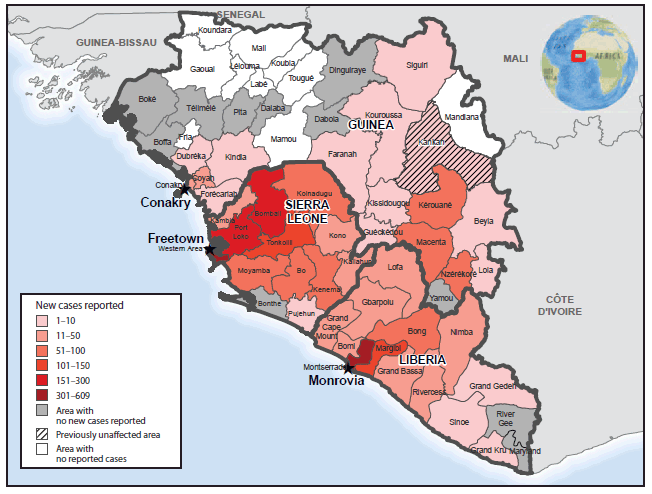
Just to give you a sense of the threat that lies outside of the door in Magbeni, here is a map of Ebola cases published by the CDC on 18th November 2014.


1.     What is the social and political situation in Sierra Leone?

The mood of people in this country is stressful, sorrowful, panic-ridden, and discouraged. People find it very difficult to leaves their homes to go elsewhere because the illness has spread evenly throughout the country.  There are many people waiting for the epidemic to end before regaining back their lives.

The government are doing their best with what is available in the country. At first it was more a case of talking rather than tackling Ebola, which was indeed a problem. The main opposition party, the Sierra Leone Peoples Party [SLPP], was using Ebola as a means of setting the ruling party, the All Peoples Congress [APC], against its citizens. This happened especially where the Ebola started in the eastern part of the country, a district called Kailahun.

The civil unrest in Freetown is a product of the heavy sanctions that have been placed upon the people. Freetown for now is not how it used to be before. The social lives of people have been cut off: nightclubs, cinemas, schools, and colleges have all been closed. Because of all these, the life of people in the capital city is very worrisome.

Having said that, the general populace now have a greater confidence in the Ebola treatment centres because of the number of patients that been discharged. The doctors are doing a fantastic job in this fight of Ebola, even though other doctors or health workers have died. But they did not relent at all. The people at first do not believe in their own doctors especially when the medical people were saying that there is no cure for Ebola.


2.    What do you perceive to be the greatest threat to Sierra Leone's recovery from Ebola.

After the ebola we are foreseeing more economic hardship as nothing is currently going on the country rather than the fighting of ebola. There will be a sever lack of medical doctors because the few we have are losing their lives to ebola. Simultaneously, there will be more to care for; more orphans, and the numbers of street children are going to increase. The economic situation, and the disruption in schooling will lead to more drop outs than before, as well as more teenage mothers.


3.    How are the students and staff coping with the events going on outside the schools?

The students are really fighting hard to cope with what is going on; they are missing the interaction with their friends who have not been able to return to the schools due to the dreadful epidemic that is roaming the country. They are now beginning to cope with the situation as we are making them think more about their education, and how we can help the others by being strong. The students are taking unit tests and also work on setting targets for themselves. They also work on literacy and even how to sensitive themselves against the virus – although we don’t ever intend that to be something they have to do at EducAid. It is very difficult for the students to know that their friends and classmates are living in the towns, cities, and countryside exposed to Ebola.

Although situations are very different to normal, staff are really working hard here. We have literacy hours where we teach ourselves with continuous essay writing, and also material making. We read and review books together, and help in the sensitisation of the epidemic and prevention tactics.


4.    How can education help in stopping Ebola?

Education can help greatly in terms of community sensitisation, and to help the country plan best for after Ebola economic hardship. Also, in Africa, diseases can easily spread because people have low knowledge about the diseases, but with education we can make sure to be able to control it quicker in the future. 


5.    What are the biggest challenges that EducAid is facing?

The biggest challenges are:
a)    How we can protect both students and staff for Ebola.
b)    Helping on communities sensitisation.
c)     What we can do to protect the orphans of Ebola
d)    Tutoring our stay-at-home girls and boys without the threat of Ebola, because it is ever more scary!


6.    What do you think is the most important message for us to get out to the people who support EducAid?

The key messages that they most know are:
a)    Learning is still going on with our home boys and girls in all the EducAid sites
b)    There is a radio recording team that is also aiding the teaching of students during Ebola time.
c)     Staff are upgrading the learning materials in all subjects.


We believe that Sierra Leonean Ebola orphans face a situation worse than war, and an article posted by the Guardian agrees.

We are trying to prepare ourselves for the fallout of Ebola. Through our #AfterEbola programme, we are preparing ourselves and our facilities for the huge influx of Ebola orphans that we will need to care for.

Without these facilities, we are likely to lose a whole new generation to psychological and social degradation. The financial situation that is likely to follow Ebola will leave children even more vulnerable and susceptible.

Please keep supporting us in our fight to prevent Ebola, and our plan for the future. Together we can make a difference.

Donate to our campaign #AfterEbola now by clicking on this link.

Follow us on Twitter, like us on facebook, and sign up to our blog on our website – you can find the signup form at the bottom of every page.


We know that Pires’ account of living with the threat of Ebola touched many of you, and to those who donated – thank you so much for your generosity. If you haven’t read the piece, you can do so here.

Thursday, November 13, 2014

A sobering experience

As the global media attention begins to tire and to sway on to other more sensational stories, it would be easy for the public to think that Ebola situation has gotten better. Let us be clear, it has not.

Have you seen the BBC piece on Kigbal, a small town 4 hours north of Freetown? Ebola has pillaged the town, with over 15% of the adult population dead and many more dying every day, the BBC describes it as the epicentre of a new surge of Ebola infections.

Our country director, Miriam, was in the same area over the weekend and she experienced even more horrific scenes. Over e-mail, Miriam wrote to me about her experience:

The little children that I was talking to today have lost everyone - both parents and often several siblings - and they are watching each other die one by one. Every day, more die. 
Please God; pray that there are some survivors so that we will have a chance to help them. I was talking to them about going to school - what else do you do? What do you say to a kid who is sitting there - maybe about to die - who has, in the last 3 weeks, watched both parents die horribly and then are being kept in the hospital. They are being looked after by Zainab Kamara the 25-year-old woman below, a survivor who has lost her husband and son but who calmly says she is ok now. 
I took some photos of the children and showed them - they were quite excited about that. Then we were talking about them going to school, and I showed them a photo of Kofi and so on. The little girl at the bottom is Adamsay and she is feeling better than she was yesterday - but is she going to live? 
It is really very sobering, Marcus.


One thing that we would like to note, specifically, is that Miriam has been trained in the best methods of avoiding contagion, and is at all times very cautious with her own manner – not getting too close to those clearly or probably infected.

This puts what we are doing in really sharp focus. There is no time left to think about it, we need your action now to help secure the lives and futures of these traumatised children. When those lucky few walk away from this terrible situation, where will they go? They will come to EducAid, where we will have a loving and caring educational and pastoral environment waiting for them.

If you are a regular donor, please think about increasing your donation to help us through this deeply troubling time. We are delivering change for the most vulnerable children on earth right now – please help us.

Help us fight for a life #AfterEbola. Donate here


Wednesday, November 12, 2014

Living with Ebola: Abu ‘Pirez’ Kanu


Pirez is a man who has come all the way through the EducAid system, and someone that typifies everything that we stand for. We asked him a few questions to give us an overview of what life is really like on the ground in Sierra Leone, from someone who is fighting the battle every day.

What is the mood like in Sierra Leone?

People are very scared, but they are still trying to go on with their normal lives. This is made very difficult due to the restrictions imposed because of Ebola; some people are trying to work, but many sectors have been closed down. There are both restrictions on certain businesses and markets, but many people are scared to receive people in to their shops for fear of Ebola. The morale in the EducAid schools is cool and calm; people are getting with their normal daily lives, though it is very worrying. It is most scary when there is a potential threatening situation close to us. Ebola affects every single Sierra Leonean; not only does everyone have contact with at least one person who has died or is ill with Ebola, many regions are closed down. This means we all suffer equally.


What do you perceive to be the greatest threat to Sierra Leone's recovery from Ebola.

The economic situation for many families, and the nation as a whole, is a huge threat.  The decline in the economy due to the closure of businesses, and the paralysis of tourism will affect many many families. I am most concerned that this also affects the resources available for the general population for things such such as education and healthcare. There is also a huge worry that Ebola will further damage the relationship of the people in our society. The economy of the nation as a whole has been seriously affected, and people are upset by the our inability to control the virus. We can see by the civil unrest and rioting that has happened already in Freetown that the nation is concerned and, because of this, I am worried that there will be many drop outs, young pregnancies, and unwanted pregnancies. I fear for the children that are not only orphaned by Ebola, but finding another lost generation.

Are people being responsible in Sierra Leone?

There are still traditional healers operating in Sierra Leone. For example, in Mathonkara and Matech, there were chiefs who were taking patients to their house until one day the authorities found dead bodies in their custody. Eventually they were sacked. The government have tried to ban all traditional healers, and I think that the general public are becoming more responsible in terms of taking practical advice on the preventive measures to curtail the spread of the Ebola virus. The advice that we, at EducAid, give is: if a family member is ill, call for the Ebola team or take them for testing or treatment at any hospital. It is also necessary to practice the measures, ABC and AUM.

A: Avoid
B: Body
C: Contact

A: Avoid
U: Unnecessary
M: Movement.


How can education help stopping Ebola?

It helps in all the procedures taken to stop the spread of the disease. It will help the people to understand the truth of the disease since the Ebola virus has a lot of symptoms. Help people to know the preventive measures, and this will help them not to contract the disease. It will also help people to know the need for not touching the dead.

What are the biggest challenges that EducAid is facing?

Getting funds to continue with the running of the EducAid schools. Having the Ministry of Education turn down our broadcasted educational programmes was horrible, as that was something that we had all worked together towards. However, the worst thing is not having most of our students with us because this means that our control over the disease is beyond our control or power.


................................................................................................................

We believe that ‘Sierra Leonean Ebola orphans face a situation worse than war, and an article posted by the Guardian agrees. We are trying to prepare ourselves for the fallout of Ebola. Through our #AfterEbola programme, we are preparing ourselves and our facilities for the huge influx of Ebola orphans that we will need to care for.

Without these facilities, we are - just as Pirez - likely to lose a whole new generation to psychological and social degradation. The financial situation that is likely to follow Ebola will leave children even more vulnerable and susceptible to the chaos.

Please keep supporting us in our fight to prevent Ebola, and our plan for the future. Together we can make a difference.

Donate to our campaign #AfterEbola now by clicking on the link.

Follow us on Twitter, like us on facebook, and sign up to our blog on our website – you can find the signup form at the bottom of every page.


If you’d like to find out more about Pirez, you can read his story below.


Like many of our alumni, Pirez is a child of war. It is estimated that 320,000 children were orphaned by this terrible and meaningless conflict, many of whom were forced in to warfare, drug use, and abuse at the hands of their elders. Having lost contact with both of his parents during the chaos of the civil war that raged from 1991 to 2002, Abubakarr Kanu, later nicknamed Pirez, found himself living with his step-mother on Karie Street, Port Loko.

Pirez’s existence was a struggle for survival. When he was young, he fought for an education and went through Primary school to sit his National Primary School Examination (NPSE) in 2002. He recognizes the achievement when he describes how difficult the circumstances were.

“Transportation to school was difficult, and I survived by eating gari that I begged from my friends.”

Pirez unfortunately had to give up going to school when the financial constraints just got too bad. Instead, he was forced to wash bikes and vehicles in order to survive. Then, in 2005, he heard about EducAid.

“When I heard about EducAid, a free school, I was glad and I enrolled at the JSS.  I worked hard and sat to the BECE. In 2006, I got promoted to the WASSCE class and successfully sat to the exam and was later retained as a volunteer teacher.”

In 2010-11 academic year Pirez was appointed as a deputy site manager. In the same year he was admitted to study at the Port Loko Teacher Training College on the distance course, and later graduated with a Div. 2 in Commercial Studies.

At the start of the 2013-2014 academic year Pirez was appointed to the role of the Deputy Staff Coordinator for EducAid country-wide. In the same year, I was later appointed as the EducAid 4M schools coordinator in the Tonkolili district, where EducAid has taken responsibility for four new primary schools. This is where he currently serves.

“My pre-EducAid life was very difficult but now things are much better with EducAid.  I am now proud of my life and EducAid in my current life.
Thanks to all those that made it possible for me.”

It is stories like Pirez’s that demonstrate the true power of education, and of EducAid. It is easy to forget how difficult it can be for individuals to reach their potential in Sierra Leone; however, considering the circumstances that Pirez came through – a youth of civil war and poverty – all he needed was the opportunity to flourish, and flourish he did.


Thursday, November 6, 2014

Necessity is the mother of invention


Necessity is the mother of invention – we can see this proverb come to reality during times of crisis, particularly in the actions and initiatives that come from the NGO and Aid communities. A few weeks ago, the West African Medical Mission (WAMM) took in some of our students to be trained in a variety of disease control and prevention classes, and general healthcare.

With the medical scenario in Sierra Leone as it is, having only 2 doctors per 100,000 people, these training initiatives can do so much to empower communities to be self-sufficient. With the death of Dr. Godfrey George, of Kambia hospital, making him the 5th doctor to have lost his life in this Ebola crisis, the ratio of doctors to population is reducing.

[1]

This self-sufficiency becomes even more important at a time of crisis. With Ebola running rife through the country, there is no capacity for health infrastructure to deal with any other kinds of illness, and could even put someone without Ebola directly in harms way. This initiative will allow us to provide the first and second line of support from within our own compounds; this will not only empower us in our own self-sufficiency, but also reduce the risk of infection from outside.

Below is a description of the WAMM programme from one of the attendees, Sulaiman M Jalloh. He is an EducAid student and an aspiring medic.

On the 21st July 2014, we undertook a programme with the WAMM at the Vine Memorial School, Congo Cross. The WAMM team presented a syllabus related to different diseases such as Malaria, Cholera, Tuberculosis, high blood pressure, HIV/AIDS, and the current emergency Ebola virus. The syllabus covered nutrition, maternal health, mental illness with other important sub topics such as genetics, cell theory, vaccines etc.

To complete all of the syllabus, we underwent more than eight weeks training in the classroom to cover all of the topics.

After the training, we were called for the second phase of the programme that is the community outreach initiative (COI). We underwent two weeks training about how to do a survey, implementation and sensitisation. After this, we were sent out to various communities like Aberdeen, Thompson Bay and Dwazak community to implement what we had learned.

After this implementation we were certified as the young scholars of 2014 as part of the West Africa medical Mission.

We thought that the programme was very educational, important and beneficial to us because, from the experience that we have gained, we now believe that we can make a change to others by passing on this experience and ideas to our colleagues and community members.

More over, we can’t say much but to thank EducAid for giving us this opportunity and support to go through this programme, even though we are now part of the WAMM programme, we still need your support.

Thank you Miriam

[1] http://www.economist.com/blogs/graphicdetail/2014/10/ebola-graphics

Wednesday, November 5, 2014

Traditions, Rites, and the Deadly Virus


‘Safe and dignified burials’ have been a top priority of the international and government agencies of the past months; with more reports of insensitivity by government burial teams – a lack of clarity as to grave locations, and a lack of religious formality to ceremonies - it is becoming a point of contention at both a localised and widespread national level.

Traditional burial rites have long been attributed as a cause for the virulent spreading of Ebola, with ceremonial body washing recognised as the main vehicle of transmission. It is all-too-easy for us, in the West, to criticise these traditional ceremonies, and to feel exasperated that they have been continued by the population for so long. Last week’s blog post investigated the reasons why youths would attack ambulances in order to prevent them being taken away to Ebola treatment centres. With no demonstrable improvement in the Ebola situation, and the treatment centre considered as a veritable death sentence, is it that difficult to see why the local population is losing faith in the international and government response? Bearing these things in mind, is it unlikely that some of these practices are still going on?

The importance of stopping these practices is incredible. As many as 350 Ebola deaths, and attributed as the main source of Ebola in Sierra Leone, have been linked back to 1 funeral - a traditional healer.[1] However, what is of equal, if not greater importance, is to ensure that Sierra Leone is unified by the counter-Ebola programmes, and not divided by them. With the very recent history that this troubled country has dealt with, it can not be allowed to slip back in to civil divisions. This factor demands us to address the problems that are currently being faced, which in turn brings the following questions in to focus: what is the importance of the religious ceremonies, and what are the social and spiritual implications of forgoing them? By identifying and addressing these things, the aid and government agencies may be able to pacify and win over an increasingly angered and alienated population.

----------------------------------------------------------------------------------------------------------------
----------------------------------------------------------------------------------------------------------------

As mentioned before, ‘Safe, and dignified burial’ has become a common phrase to have come out of the Ebola outbreak, particularly from government agencies and large NGOs. Contained within this succinct axiom is a socially and politically charged context. I mentioned in a previous bog post that the government and NGOs had come under popular criticism over the insensitive handling of burials, and that they would need to achieve the appropriate balance between swift and decisive burials, as well as accountability and sensitivity.

There are two issues addressed by the aforementioned phrase. The first is obvious – safety; Ebola-infected bodies are at their most contagious at the point of death, and they need to be contained and buried quickly in order to avoid any further unnecessary contagion. The second is more of a social issue – dignity; there is a responsibility on the burial teams and coordinators to maintain the religious respect for the deceased, and their families. The case that we featured last week demonstrated that this fine balance had not been struck - if you didn’t read the post, it contained the story of a family not being informed where their loved one had been buried – however, this sad story only covers one of the crucial elements of of the dignity that is sought.

A common justification for the virulent spread of Ebola has been the much-criticized ‘traditional burial practices’. Aside from not hearing what else was involved in a West African burial practice, other than the washing of the bodies, it struck me that I had not read any article around the history of these religious and social practices, nor the spiritual implications of forgoing them. Thus, I was finding it difficult to contextualise the anger and fervour that was being played out in the, seemingly, thoughtless crimes featured in last week’s blog.

M. Douglas Henry, on the everyculture.com website, writes that “reports often list Sierra Leoneans as 60 percent Muslim, 10 percent Christian, and 30 percent "indigenous believers." These kinds of numbers often mask the degree to which religious beliefs in Sierra Leone may be flexible and accommodating. One can go to a Christian church on Sunday, for example, and still make a sacrifice to one's ancestors for good fortune. Likewise, Muslim rituals may appear to dominate in some areas, yet these can become mixed with indigenous ideas or customs….”[2]

The indigenous ideas or customs, which Henry mentions in this description, predominantly refers to West African Animism. Wikipedia describes Animism as “encompass[ing] the belief that there is no separation between the spiritual and physical (or material) world, and souls or spirits exist, not only in humans, but also in some other animals, plants, rocks, geographic features such as mountains or rivers, or other entities of the natural environment, including thunder, wind, and shadows.”[3] Allan Anderson on deathreference.com describes it like this: “In the religions of Africa, life does not end with death, but continues in another realm. The concepts of "life" and "death" are not mutually exclusive concepts, and there are no clear dividing lines between them. Human existence is a dynamic process involving the increase or decrease of "power" or "life force," of "living" and "dying," and there are different levels of life and death.

Death in African religions is one of the last transitional stages of life requiring passage rites, and this too takes a long time to complete. The deceased must be "detached" from the living and make as smooth a transition to the next life as possible because the journey to the world of the dead has many interruptions. If the correct funeral rites are not observed, the deceased may come back to trouble the living relatives.” [4]

From a Western perspective we govern the division of our soul and body in death by the philosophy of Cartesian Dualism, meaning that the two selves occupy different realms of existence distinct from one another. Following this thinking, the ceremony of the funeral is therefore not one to liberate the soul, for it exists separately, but one for remembrance and tribute. In Animist belief, this is not the case; the soul is carried in the body and requires these specific rites and rituals to be enacted in order to send the soul on it’s path to the afterlife.

“Many African burial rites begin with the sending away of the departed with a request that they do not bring trouble to the living, and they end with a plea for the strengthening of life on the earth and all that favours it. Funerals are a time for the community to be in solidarity and to regain its identity. In some communities this may include dancing and merriment for all but the immediate family, thus limiting or even denying the destructive powers of death and providing the deceased with "light feet" for the journey to the other world.” [5] “Specific burial customs may vary by region or religion, yet practically all of them encompass a firm conviction in the existence of God and the spirit world, and especially in the abilities of one's deceased ancestors to intervene in the activities of everyday life. Sacrifices, ritual remembrances, and prayer are made in order enlist ancestors' support and good favor.”[6]

Regarding the majority of these traditional practices, there is sufficient evidence that points to Animism as their source. However, there is some contradiction and confusion surrounding the origins of the ceremonial body-washing that takes place in West Africa. The practice is common in Islam, and many speculate that it is an African adoption that stems from the spread of Islam to sub-Saharan Africa. The practice is of sufficient importance that some Imams have issued statements to local communities to dissuade them from undertaking the traditional practice of ghusl.

Sheikh Ahmad Kutty, a senior lecturer and an Islamic scholar at the Islamic Institute of Toronto, Ontario, Canada, states that “Islamic laws are based primarily on the benefit and well-being of humankind. As such, preservation of life and health is of greater priority in Islam than conducting the funeral rites over the deceased. Accordingly, if handling the dead body entails risk to the living, we are allowed to skip the former for the greater benefit of saving lives…Therefore, if washing the dead causes harm to the lives, we should avoid it in order to prevent spreading of the disease and, hence, the deaths.” [7]

Many of the other burial practices, which as a result of Ebola are unable to be enacted, hold a significant spiritual meaning for these communities. Due to the mixed nature of spirituality in the country, it is easy to see that one religious group’s absolution would not suffice. M. Douglas Henry notes that “besides Muslim and Christian holy leaders, there are a number of indigenous religious practitioners who are able to mediate with the spirit world. These include diviners, healers, men's and women's society elders, and witchcraft specialists.”[8] The prevalence of these religious practitioners, and, ironically, the importance of controlling these burial methods, is no better typified than in one of the greatest single events to have spread Ebola in to Sierra Leone. Early on in the Ebola outbreak, one child’s death was traced back to a Kailahun funeral. “The vicinity around Kailahun was home to a well-known and widely-respected traditional healer. Her famous healing powers were also known across the border in Guinea. As the outbreak in Guinea continued to swell, desperate patients sought her care.

Predictably, the healer became infected with the Ebola virus and died. Mourners came by the hundreds, also from other nearby towns, to honour her memory by participating in the traditional funeral and burial ceremony. Quick investigations by local health authorities suggested that participation in that funeral could be linked to as many as 365 Ebola deaths.”[9]

The interruption of the traditional funeral ceremony must be a troubling thing for these communities. Aside from the inevitable trauma that in an Ebola death, the inability for a family and community to bury their dead with the proper rites must be a deeply troubling thing. It has led to instances of stigmatisation of the dead that brings dishonour to the family.

The WHO recognises this fact. In a 17-page long handbook, entitled ‘How to conduct safe and dignified burial of a patient who has died from suspected or confirmed Ebola virus disease’, it says that “The burial process is very sensitive for the family and the community and can be the source of trouble or even open conflict. Before starting any procedure the family must be fully informed about the dignified burial process and their religious and personal rights to show respect for the deceased. Ensure that the formal agreement of the family has been given before starting the burial.”[10]

Considering these elements - and those that we covered in last week’s blog post, where youths had attacked 4 ambulances on the Port Loki road - we can begin to understand the passion that these communities feel towards the treatment of their deceased. However, the story of the traditional healer whose funeral led to the death of over 350 people exemplifies the exact reason that we need to press on with these unpopular, but safe, methods of burial. It is important that we do not look on with cold pragmatism, but it is also essential that we put the greater good of the country and the world before individuals. Unfortunately, we have a humanitarian crisis on our hands, and Sierra Leone will be feeling the consequences for many years to come.

The death toll is rising, and there are still calls from those NGOs operating within the country for greater international assistance and further commitments of aid, human resources, and money. There are serious shortfalls in the assistance that countries have so far provided, and Sierra Leone truly needs your compassion and help. As we’ve explained before, we are not in the position to contain the outbreak. We are fighting every day to control our own population and keep our compounds safe. However, once the virus has been controlled, we will be there to pick up the pieces. With your help, we have plans in motion to provide accommodation, education, and pastoral care for as many of those orphans of Ebola as we can manage.


[1] http://www.who.int/csr/disease/ebola/ebola-6-months/sierra-leone/en/
[2] http://www.everyculture.com/Sa-Th/Sierra-Leone.html#ixzz3I6IEkTQI
[3] http://en.wikipedia.org/wiki/Animism
[4] http://www.deathreference.com/A-Bi/African-Religions.html#ixzz3I7HtPrwE
[5] http://www.deathreference.com/A-Bi/African-Religions.html#ixzz3I7HtPrwE
[6] http://www.everyculture.com/Sa-Th/Sierra-Leone.html#ixzz3I6IEkTQI
[7] http://www.onislam.net/english/news/africa/476119-muslims-cautioned-against-washing-ebola-dead.html
[8] http://www.everyculture.com/Sa-Th/Sierra-Leone.html#ixzz3I6IEkTQI
[9] http://www.who.int/csr/disease/ebola/ebola-6-months/sierra-leone/en/
[10]http://apps.who.int/iris/bitstream/10665/137379/1/WHO_EVD_GUIDANCE_Burials_14.2_eng.pdf?ua=1